
Adaptability of clinical pharmacist led interventions in the management of anemia of chronic renal disease: optimizing care
DOI:
https://doi.org/10.56782/pps.243Keywords:
Chronic Kidney Disease, Anemia Management, Clinical Pharmacists Intervention, Pharmaceutical CareAbstract
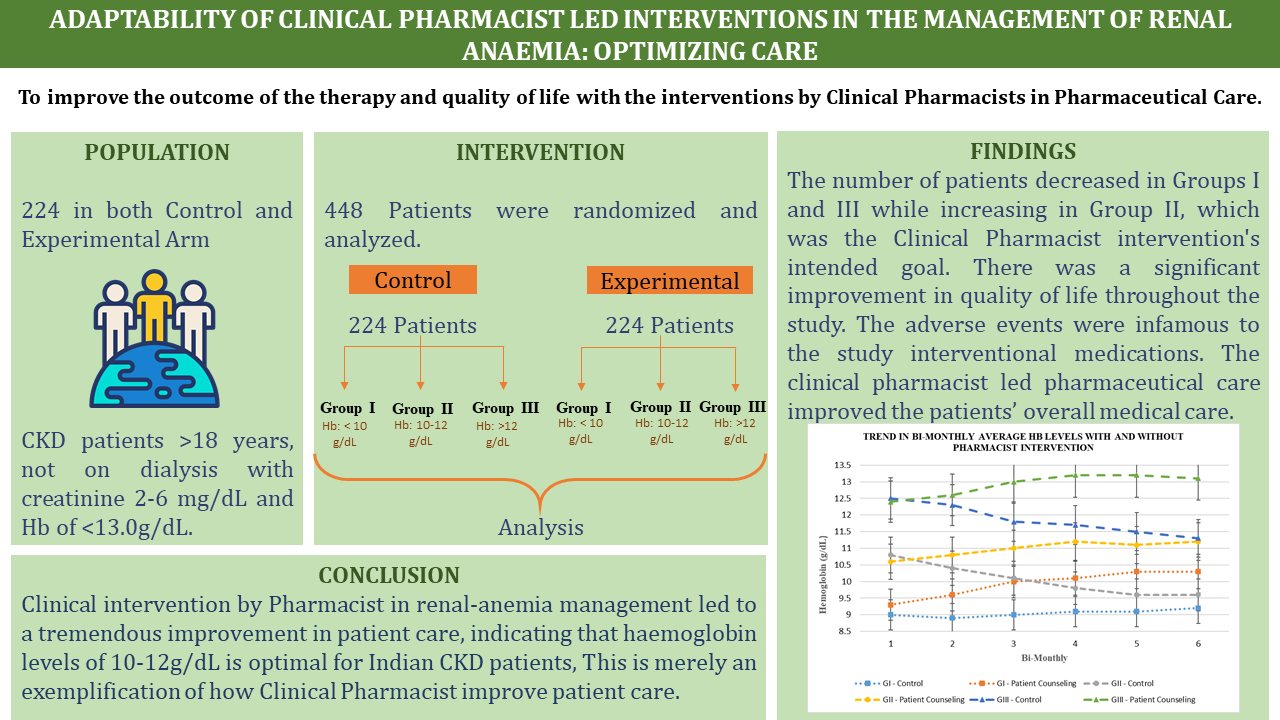
Renal anemia is a common comorbidity in chronic kidney disease (CKD) patients, typically treated with erythropoiesis-stimulating agents (ESAs) like erythropoietin. However, both over- and under-treatment are prevalent. In 2008, the Pharmacy Council of India introduced the Pharm.D course to enhance pharmaceutical care in clinical settings. While extensive studies in other countries highlight the benefits of clinical pharmacists' interventions, Indian research on this topic is limited. This prospective randomized controlled trial included CKD patients not on dialysis, with serum creatinine levels of 2-6 mg/dL and hemoglobin (Hb) levels below 12 g/dL. Participants were divided into three subgroups based on baseline Hb levels: < 10 g/dL (Group I), 10-12 g/dL (Group II), and >12 g/dL (Group III). ESAs and iron supplements were adjusted to maintain Hb levels of 10-12 g/dL. Quality of life was assessed using the Short Form Health Survey-36 questionnaire. Out of 448 participants, those in the pharmacist intervention group showed a significant shift towards Group II by the trial's end, compared to the control group. The study demonstrated a significant improvement in quality of life and physical performance, particularly for those in Group II, indicating that maintaining Hb levels at 10-12 g/dL is optimal for Indian CKD patients. This trial exemplifies the profound impact clinical pharmacists can have on patient care, highlighting their crucial role in improving healthcare outcomes through active participation and targeted interventions in clinical settings.
Downloads
References
. Clement, F. M.; Klarenbach, S.; Tonelli, M.; Johnson, J. A.; Manns, B. J. The Impact of Selecting a High Hemoglobin Target Level on Health-Related Quality of Life for Patients with Chronic Kidney Disease. Arch. Intern. Med. 2009, 169 (12), 1104. DOI: 10.1001/archinternmed.2009.112 DOI: https://doi.org/10.1001/archinternmed.2009.112
Kim, S. M.; Kim, K. M.; Kwon, S. K.; Kim, H.-Y. Erythropoiesis-Stimulating Agents and Anemia in Patients with Non-Dialytic Chronic Kidney Disease. J. Korean Med. Sci. 2016, 31 (1), 55–60. DOI: 10.3346/jkms.2016.31.1.55 DOI: https://doi.org/10.3346/jkms.2016.31.1.55
Tsuruya, K.; Hayashi, T.; Yamamoto, H.; Hase, H.; Nishi, S.; Yamagata, K.; Nangaku, M.; Wada, T.; Uemura, Y.; Ohashi, Y.; Hirakata, H. Renal Prognoses by Different Target Hemoglobin Levels Achieved by Epoetin Beta Pegol Dosing to Chronic Kidney Disease Patients with Hyporesponsive Anemia to Erythropoiesis-Stimulating Agent: A Multicenter Open-Label Randomized Controlled Study. Clin. Exp. Nephrol. 2021, 25 (5), 456–466. DOI: 10.1007/s10157-020-02005-4. DOI: https://doi.org/10.1007/s10157-020-02005-4
Singh, A. K.; Szczech, L.; Tang, K. L.; Barnhart, H.; Sapp, S.; Wolfson, M.; Reddan, D. Correction of Anemia with Epoetin Alfa in Chronic Kidney Disease. N. Engl. J. Med. 2006, 355 (20), 2085–2098. DOI: 10.1056/nejmoa065485 DOI: https://doi.org/10.1056/NEJMoa065485
Drüeke, T. B.; Parfrey, P. S. Summary of the KDIGO Guideline on Anemia and Comment: Reading between the (Guide)Line(S). Kidney Int. 2012, 82 (9), 952–960. DOI: 10.1038/ki.2012.270 DOI: https://doi.org/10.1038/ki.2012.270
Ene-Iordache, B.; Perico, N.; Bikbov, B.; Carminati, S.; Remuzzi, A.; Perna, A.; Islam, N.; Bravo, R. F.; Aleckovic-Halilovic, M.; Zou, H.; Zhang, L.; Gouda, Z.; Tchokhonelidze, I.; Abraham, G.; Mahdavi-Mazdeh, M.; Gallieni, M.; Codreanu, I.; Togtokh, A.; Sharma, S. K.; Koirala, P. Chronic Kidney Disease and Cardiovascular Risk in Six Regions of the World (ISN-KDDC): A Cross-Sectional Study. Lancet Glob. Health 2016, 4 (5), e307–e319. DOI: 10.1016/s2214-109x(16)00071-1 DOI: https://doi.org/10.1016/S2214-109X(16)00071-1
Varma, P. P. Prevalence of Chronic Kidney Disease in India - Where Are We Heading? Indian J. Nephrol. 2015, 25 (3), 133–133. DOI: 10.4103/0971-4065.148304 DOI: https://doi.org/10.4103/0971-4065.148304
Kovesdy, C. P. Epidemiology of Chronic Kidney Disease: An Update 2022. Kidney Int. Suppl. 2022, 12 (1), 7–11. DOI: 10.1016/j.kisu.2021.11.003 DOI: https://doi.org/10.1016/j.kisu.2021.11.003
Wilson, S.; Wahler, R.; Brown, J.; Doloresco, F.; Monte, S. V. Impact of Pharmacist Intervention on Clinical Outcomes in the Palliative Care Setting. Am. J. Hosp. Palliat. Care 2010, 28 (5), 316–320. DOI: 10.1177/1049909110391080 DOI: https://doi.org/10.1177/1049909110391080
Onatade, R.; Appiah, S.; Stephens, M.; Garelick, H. Evidence for the Outcomes and Impact of Clinical Pharmacy: Context of UK Hospital Pharmacy Practice. Eur J Hosp Pharm 2017, 25 (e1), e21–e28. DOI: 10.1136/ejhpharm-2017-001303 DOI: https://doi.org/10.1136/ejhpharm-2017-001303
Drüeke, T. B. Lessons from Clinical Trials with Erythropoiesis-Stimulating Agents (ESAs). Ren. Replace. Ther. 2018, 4 (1), Art. No: 46. DOI: 10.1186/s41100-018-0187-2 DOI: https://doi.org/10.1186/s41100-018-0187-2
Karimi, Z.; Hadi Raeisi Shahraki; Abdollah Mohammadian-Hafshejani. Investigating the Relationship between Erythropoiesis-Stimulating Agents and Mortality in Hemodialysis Patients: A Systematic Review and Meta-Analysis. PloS one 2023, 18 (11), e0293980–e0293980. DOI: 10.1371/journal.pone.0293980 DOI: https://doi.org/10.1371/journal.pone.0293980
Shah, A. A.; Donovan, K.; Seeley, C.; Dickson, E. A.; Palmer, A. J. R.; Doree, C.; Brunskill, S.; Reid, J.; Acheson, A. G.; Sugavanam, A.; Litton, E.; Stanworth, S. J. Risk of Infection Associated with Administration of Intravenous Iron: A Systematic Review and Meta-Analysis. JAMA Netw. Open 2021, 4 (11), e2133935–e2133935. DOI: 10.1001/jamanetworkopen.2021.33935 DOI: https://doi.org/10.1001/jamanetworkopen.2021.33935
National Kidney Foundation. Aging and Kidney Disease. National Kidney Foundation. https://www.kidney.org/news/monthly/wkd_aging#:~:text=Kidney%20disease%20can%20develop%20at. [Accessed on 15 May 2024]
Chronic Kidney Disease in United States, 2023. Centers for Disease Control and Prevention. https://www.cdc.gov/kidneydisease/publications-resources/ckd-national-facts.html#:~:text=CKD%20is%20more%20common%20in,%25)%20than%20men%20(12%25. [Accessed 15 May 2024].
Lewandowski, M. J.; Krenn, S.; Kurnikowski, A.; Bretschneider, P.; Sattler, M.; Schwaiger, E.; Antlanger, M.; Gauckler, P.; Pirklbauer, M.; Brunner, M.; Horn, S.; Zitt, E.; Kirsch, B.; Windpessl, M.; Wallner, M.; Aringer, I.; Wiesholzer, M.; Hecking, M.; Hödlmoser, S. Chronic Kidney Disease Is More Prevalent among Women but More Men than Women Are under Nephrological Care. Wien. Klin. Wochenschr. 2022, 135, 89–96. DOI: 10.1007/s00508-022-02074-3 DOI: https://doi.org/10.1007/s00508-022-02074-3
Sinnakirouchenan, R.; Holley, J. L. Peritoneal Dialysis versus Hemodialysis: Risks, Benefits, and Access Issues. Adv. Chronic Kidney Dis. 2011, 18(6), 428–432. DOI: 10.1053/j.ackd.2011.09.001 DOI: https://doi.org/10.1053/j.ackd.2011.09.001
Diabetes and Chronic Kidney Disease. Centers for Disease Control and Prevention. https://www.cdc.gov/diabetes/managing/diabetes-kidney-disease.html#:~:text=How%20Diabetes%20Causes%20Kidney%20Disease,as%20well%20as%20they%20should. [Accessed 20 May 2024].
Hypertension in CKD: Core curriculum 2019. National Kidney Foundation. https://www.ajkd.org/article/S0272-6386%2819%2930094-0/fulltext#:~:text=The%20mechanisms%20of%20hypertension%20in,ESKD)%20in%20the%20United%20States. [Accessed 20 May 2024].
Ardavani, A.; Curtis, F.; Khunti, K.; Wilkinson, T. J. The Effect of Pharmacist‐Led Interventions on the Management and Outcomes in Chronic Kidney Disease (CKD): A Systematic Review and Meta‐Analysis Protocol. Health Sci. Rep. 2023, 6(1), Art. No: e1064. DOI: 10.1002/hsr2.1064 DOI: https://doi.org/10.1002/hsr2.1064
Marouf, B. H.; Ahmed Yusif, I.; Najim, R. H. Role of Pharmacist Intervention in the Management of Anemia Associated with Chronic Kidney Diseases at the Hemodialysis Setting. J. Young Pharm. 2020, 12 (2), 162–168. DOI: 10.5530/jyp.2020.12.33 DOI: https://doi.org/10.5530/jyp.2020.12.33
Downloads
Published
Issue
Section
License
Copyright (c) 2024 Girish B S, Srinivasan R, Joel M. Johns, C S Meghana

This work is licensed under a Creative Commons Attribution 4.0 International License.
For all articles published in Prospects in Pharmaceutical Sciences copyright is retained by the authors. The journal publishes articles in the Open Access policy, within the CC BY 4.0 licence.
This is a human-readable summary of (and not a substitute for) the license. Disclaimer.
You are free to:
Share — copy and redistribute the material in any medium or format
Adapt — remix, transform, and build upon the material for any purpose, even commercially.
The licensor cannot revoke these freedoms as long as you follow the license terms.
Under the following terms:
Attribution — You must give appropriate credit, provide a link to the license, and indicate if changes were made. You may do so in any reasonable manner, but not in any way that suggests the licensor endorses you or your use.
No additional restrictions — You may not apply legal terms or technological measures that legally restrict others from doing anything the license permits.
Notices:
You do not have to comply with the license for elements of the material in the public domain or where your use is permitted by an applicable exception or limitation.
No warranties are given. The license may not give you all of the permissions necessary for your intended use. For example, other rights such as publicity, privacy, or moral rights may limit how you use the material.
How to Cite




