
Current trends in manufacturing for large volume parenteral in the pharmaceutical industry and future scopes
DOI:
https://doi.org/10.56782/pps.245Keywords:
Large Volume Parenteral, Quality Assurance, Production, Automation, Pharmaceutical industryAbstract
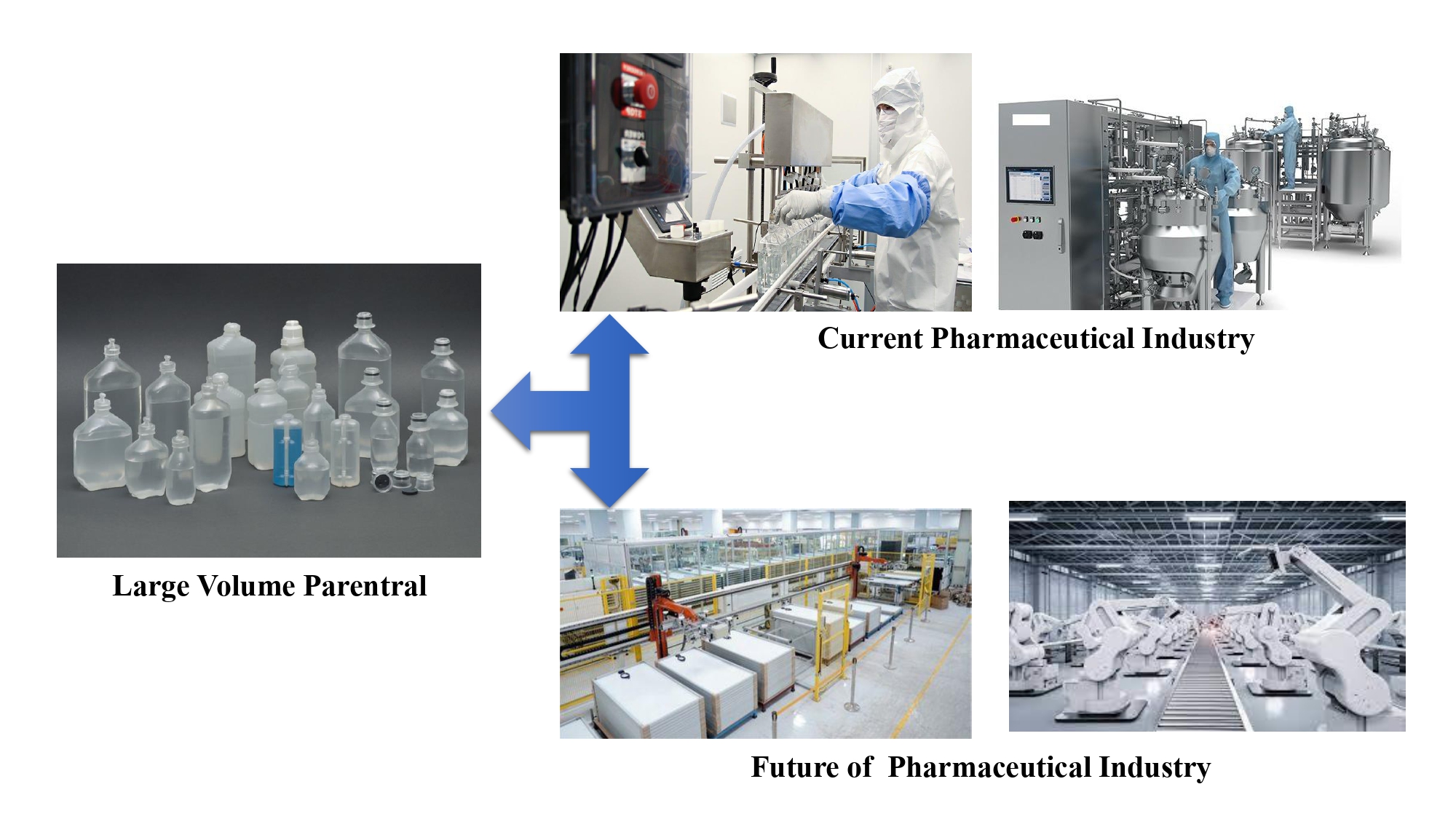
The current features of manufacturing of Large Volume Parenteral from receiving the API and excipient to the final dispatch of product addressed many features including, sampling errors, manufacturing errors other controls, and individuals involved in various phases. The pharmaceutical industry nowadays places a greater focus on production-related issues like handling manpower and quality-related problems and implementing systems like Good Manufacturing Practises, and other systems. To reduce reliance on humans and raise the quality of products, future trends and possibilities in automation in various areas like production, quality assurance, and quality controls were discussed in this paper. For the production of an enormous quantity of parentals, the roles and responsibilities of both the manufacturing team and the quality assurance team are crucial. Future manufacturing initiatives can reduce labour expenses while enhancing product quality, nevertheless, they will also encourage more automation research and development.
Downloads
References
1. Muheem, A.; Zafar, S.; Jahangir, M.A.; Warsi, M.H.; Imam, S.S.; Jain, G.K.; Ahmad, F.J. Recent advances in the development of parenteral dosage forms. In: Pharmaceutical Drug Product Development and Process Optimization. Beg, S.; Al Robaian, M.; Rahman, M.; Imam, S.S.; Alruwaili, N.; Panda, S,K. Eds. Apple Academic Press 2020, New York, USA, pp. 97–124. DOI: https://doi.org/10.1201/9780367821678-5
2. Birrer, G.A. Parenteral dosage forms. In Handbook of Modern Pharmaceutical Analysis; Elsevier: Amsterdam, The Netherlands, 2001. DOI: https://doi.org/10.1016/S0149-6395(01)80009-X
3. Fisher, A.C.; Lee, S.L.; Harris, D.P.; Buhse, L.; Kozlowski, S.; Yu, L.; Kopcha, M.; Woodcock, J. Advancing pharmaceutical quality: An overview of science and research in the US FDA’s Office of Pharmaceutical Quality. Int. J. Pharm. 2016, 515, 390–402. DOI: 10.1016/j.ijpharm.2016.10.039. DOI: https://doi.org/10.1016/j.ijpharm.2016.10.038
4. Sambhakar, S.; Malik, R.; Bhatia, S.; Al Harrasi, A.; Rani, C.; Saharan, R.; Kumar, S.; Sehrawat, R. Nanoemulsion: An emerging novel technology for improving the bioavailability of drugs. Scientifica 2023, 2023, Art. No: 622710. DOI: 10.1155/2023/622710. DOI: https://doi.org/10.1155/2023/6640103
5. Lambert, B.J.; Hansen, J.M.; Bryans, T.D.; Lam, S. Sterility assurance across-sectors—New paradigms and tools. Front. Med. Technol. 2021, 3, Art. No: 622710. DOI: 10.3389/fmedt.2021.622710. DOI: https://doi.org/10.3389/fmedt.2021.622710
6. Merivaara, A.; Zini, J.; Koivunotko, E.; Valkonen, S.; Korhonen, O.; Fernandes, F.M.; Yliperttula, M. Preservation of biomaterials and cells by freeze-drying: Change of paradigm. J. Control. Rel. 2021, 336, 480–498. DOI: 10.1016/j.jconrel.2021.06.018. DOI: https://doi.org/10.1016/j.jconrel.2021.06.042
7. Rayaprolu, B.M.; Strawser, J.J.; Anyarambhatla, G. Excipients in parenteral formulations: Selection considerations and effective utilization with small molecules and biologics. Drug Dev. Ind. Pharm. 2018, 44, 1565–1571. DOI: 10.1080/03639045.2018.1508282. DOI: https://doi.org/10.1080/03639045.2018.1483392
8. Center for Biologics Evaluation, Research. Container and closure system integrity testing in lieu of sterility testing as a component of the stability protocol for sterile products. Available online: https://www.fda.gov/regulatory-information/search-fda-guidance-documents/container-and-closure-system-integrity-testing-lieu-sterility-testing-component-stability-protocol (accessed on 4 May 2024).
9. Current Good Manufacturing Practice (CGMP) regulations. Available online: https://www.fda.gov/drugs/pharmaceutical-quality-resources/current-good-manufacturing-practice-cgmp-regulations (accessed on 4 May 2024).
10. Facts about the current good manufacturing practices (CGMP). Available online: https://www.fda.gov/drugs/pharmaceutical-quality-resources/facts-about-current-good-manufacturing-practice-cgmp (accessed on 4 May 2024).
11. Guidance for Industry, Q7A Good Manufacturing Practice Guidance for Active Pharmaceutical Ingredients. Available online: https://www.fda.gov/regulatory-information/search-fda-guidance-documents/guidance-industry-q7a-good-manufacturing-practice-guidance-active-pharmaceutical-ingredients (accessed on 4 May 2024).
12. Baetz, B.W. Parenteral packaging waste reduction. Can. J. Hosp. Pharm. 1990, 43, 179–195.
13. Training and continuing education. Available online: https://www.fda.gov/training-and-continuing-education (accessed on 4 May 2024).
14. Vora, L.K.; Gholap, A.D.; Jetha, K.; Thakur, R.R.; Solanki, H.K.; Chavda, VP. Artificial intelligence in pharmaceutical technology and drug delivery design. Pharmaceutics 2023, 15, Art. No: 1916. DOI: 10.3390/pharmaceutics15071916. DOI: https://doi.org/10.3390/pharmaceutics15071916
15. Thermolabile. Available online: https://home.csulb.edu/~cwallis/482/visualsystem/lexicon.html (accessed on 29 October 2024).
16. IPMOGrifols LTD. Terminal sterilization for parenteral drugs: Finding the right CDMO partner. Available online: https://www.pharmasalmanac.com/articles/terminal-sterilization-for-parenteral-drugs-finding-the-right-cdmo-partner (accessed on 29 October 2024).
Downloads
Published
Issue
Section
License
Copyright (c) 2025 Tarang Patel, Vatsal Patel, Mehul Patel, Umang Shah, Ashish Patel, Swayamprakash Patel, Nilay Solanki

This work is licensed under a Creative Commons Attribution 4.0 International License.
For all articles published in Prospects in Pharmaceutical Sciences copyright is retained by the authors. The journal publishes articles in the Open Access policy, within the CC BY 4.0 licence.
This is a human-readable summary of (and not a substitute for) the license. Disclaimer.
You are free to:
Share — copy and redistribute the material in any medium or format
Adapt — remix, transform, and build upon the material for any purpose, even commercially.
The licensor cannot revoke these freedoms as long as you follow the license terms.
Under the following terms:
Attribution — You must give appropriate credit, provide a link to the license, and indicate if changes were made. You may do so in any reasonable manner, but not in any way that suggests the licensor endorses you or your use.
No additional restrictions — You may not apply legal terms or technological measures that legally restrict others from doing anything the license permits.
Notices:
You do not have to comply with the license for elements of the material in the public domain or where your use is permitted by an applicable exception or limitation.
No warranties are given. The license may not give you all of the permissions necessary for your intended use. For example, other rights such as publicity, privacy, or moral rights may limit how you use the material.
How to Cite




