
The methods of synthesis of 2-aminobenzophenones — key precursors of 1,4-benzodiazepines
DOI:
https://doi.org/10.56782/pps.232Keywords:
2-aminobenzophenones, 1,4-benzodiazepines, drug synthesis, organic synthesis, disconnection approachAbstract
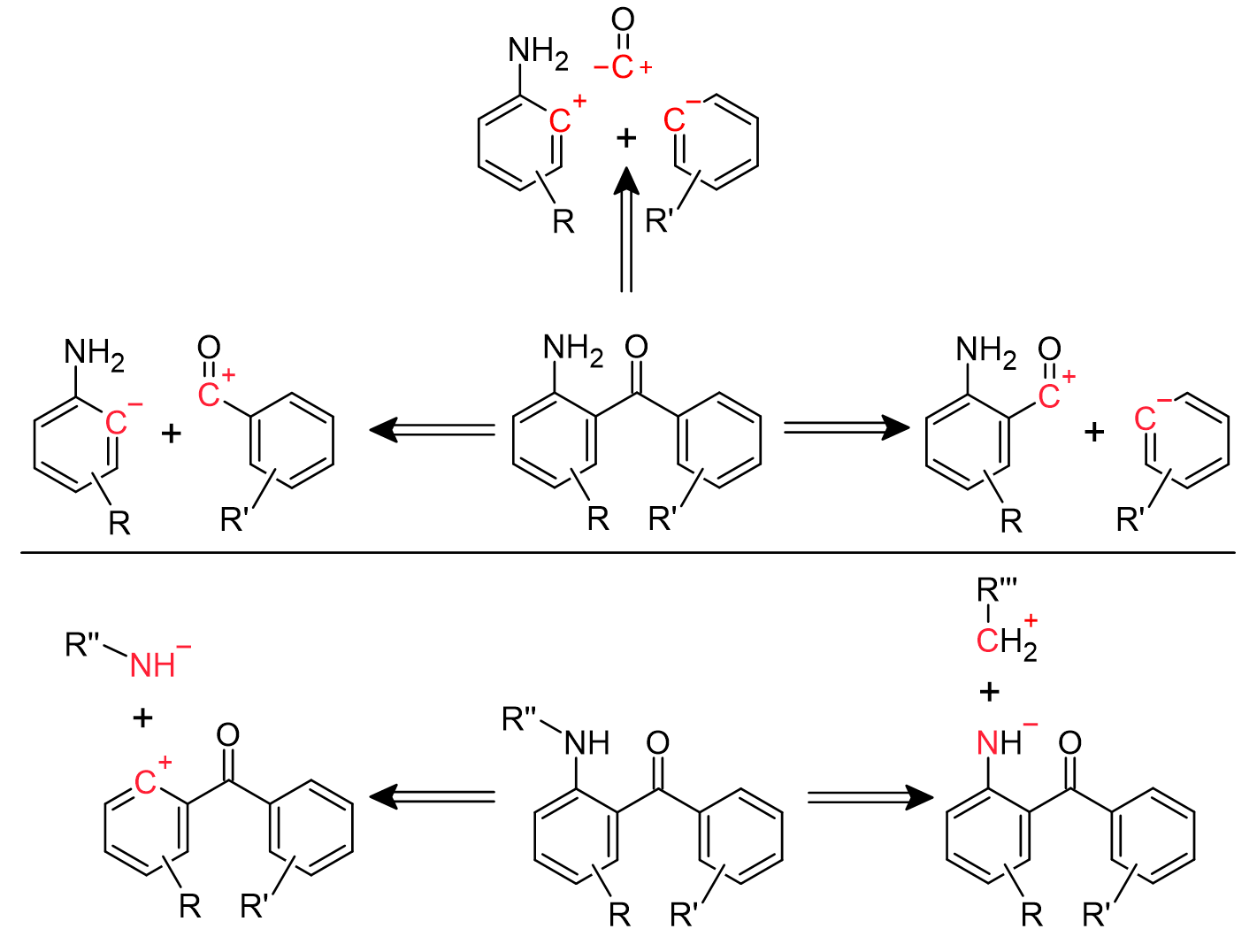
The review article briefly presents the pharmacological profile and mechanism of action of 1,4-dibenzodiazepines, and the structures of the most important drugs from this class of compounds. The strongest emphasis is placed on presentation of various methods for the synthesis of 2-aminobenzophenones — the most often used precursors in the synthesis of 1,4-benzodiazepines and numerous classes of azaarenes. The reactions or their sequences were grouped according to retrosynthetic strategies based on structural similarities and differences of the reagents used. There were presented not only the most classical methods like Friedel-Crafts acylation or Grignard reaction, but also more advanced transformations utilizing various catalysts and more sophisticated approaches involving the synthesis of heterocyclic systems followed by their reductive or oxidative cleavage. Selected nuances of the presented reactions were discussed, including fragments of mechanisms, limitations of the applicability of a given method, and the advantages of modern solutions over the oldest and more classical methods.
Downloads
References
Silverman, R.B. Chemia organiczna w projektowaniu leków, 1st ed.; WNT, Warsaw, Poland, 2004, pp. 8-11.
Edilma Sanabria, E.; Cuenca, R.E.; Esteso, M. Á; Maldonado, M. Benzodiazepines: Their Use either as Essential Medicines or as Toxics Substances, Toxics 2021, 9, 2, 25, 1-18. doi.org/10.3390/toxics9020025 DOI: https://doi.org/10.3390/toxics9020025
Zejc, A.; Gorczyca, M. Chemia leków, 3rd ed.; PZWL, Warsaw, Poland, 1998, pp. 100-107, 137-139, 149.
Mutschler, E.; Geisslinger, G.; Kroemer, H.K.; Ruth, P.; Schafer-Korting, M. Kompendium farmakologii i toksykologii Mutschlera, 1st ed.; MedPharm, Wrocław, Poland, 2008, pp. 85-86.
Brunton, L.; Parker, K.; Blumenthal, D.; Buxton, I. Podręcznik farmakologii i terapii Goodmana i Gilmana, 1st ed.; Czelej, Lublin, Poland 2010, pp. 171-176.
Nowacki M. Opracowanie technologii przekształcania estru etylowego kwasu 6-(2-bromofenylo)-8-fluoro-4H-imidazo[1,5-a][1,4]benzodiazepino-3-karboksylowego w amid (Imidazenil). Master's Thesis, Warsaw University of Technology, Warsaw, Poland, 2013.
Sugasawa, T.; Toyoda, T.; Adachi, M.; Sasakura, K.; Aminohaloborane in Organic Synthesis. 1. Specific Ortho Substitution Reaction of Anilines. J. Org. Chem. 1978, 100, 15, 4842-4852. doi.org/10.1021/ja00483a034 DOI: https://doi.org/10.1021/ja00483a034
Nowacki, M. Opracowanie metody otrzymywania i oczyszczania 2–amino–2’–bromo–5–fluorobenzofenonu – substratu do syntezy preparatu Imidazenil. Engineer's Thesis, Warsaw University of Technology, Warsaw, Poland, 2012.
Skarżewski, J. Wprowadzenie do syntezy organicznej, 1st ed.; PWN, Łódź, Poland, 1999, pp. 18-25.
Sternbach, L.H.; Ian Fryer, R.; Metlesics, W.; Sach, G.; Stempel, A.; Quinazolines and 1,4-Benzodiazepines. V. o-Amonobenzophenones. J. Org. Chem. 1962, 27, 3781-3788. doi.org/10.1021/jm00339a010 DOI: https://doi.org/10.1021/jo01058a009
Hu, W.; Guo, Z.; Chu, F.; Bai, A.; Yi, X.; Cheng, G.; Li, J. Synthesis and Biological Evaluation of Substituted 2-Sulfonyl-phenyl-3-phenyl-indoles: A New Series of Selective COX-2 Inhibitors, Bioorg. Med. Chem. 2003, 11, 1153-1160. doi.org/10.1016/S0968-0896(03)00046-4 DOI: https://doi.org/10.1016/S0968-0896(03)00046-4
Atechian, S.; Nock, N.; Norcross, R.D.; Ratni, H.; Thomas, A.W.; Verron, J.; Masciadri R. New vistas in quinoline synthesis, Tetrahedron 2007, 63, 2811–2823. doi.org/10.1016/j.tet.2007.01.050 DOI: https://doi.org/10.1016/j.tet.2007.01.050
Walsh, D.A. The Synthesis of 2-Aminobenzophenones. Synthesis 1980, 9, 677-688. doi.org/10.1055/s-1980-29169 DOI: https://doi.org/10.1055/s-1980-29169
Hewawasam, P.; Fan, W.; Knipe, J.; Moon, S.L.; Boissard, C.G.; Gribkoff, V.K.; Starrett, J.E.; The Synthesis and Structure-Activity Relationships of 4-Aryl-3-aminoquinolin-2-ones: A New Class of Calcium-Dependent, Large Conductance, Potassium (Maxi-K) Channel Openers Targeted for Post-Stroke Neuroprotection, Bioorg. Med. Chem. Lett. 2002, 12, 1779-1783. doi: 10.1016/S0960-894X(02)00240-8 DOI: https://doi.org/10.1016/S0960-894X(02)00240-8
Sternbach, L.H.; Montclair, U.; Saucy, G.; United State Patent 1967, No. 3,297,755, 1967.
Kappe, T.; Stadlbauer, W.; Isatoic Anhydrides and Their Use in Heterocyclic Synthesis, Adv. Heterocycl. Chem. 1981, 28, 127-134. doi.org/10.1016/S0065-2725(08)60042-2 DOI: https://doi.org/10.1016/S0065-2725(08)60042-2
Treweek, J.B.; Sun, Ch.;, Mayorov, A.V.; Qi, L.; Levy, C.L.; Roberts, A.J.; Dickerson, T.J.; Janda, K.D. Prevention of Drug-Induced Memory Impairment by Immunopharmacotherapy, J. Med. Chem. 2008, 51, 6866-6875. doi.org/10.1021/jm800506v DOI: https://doi.org/10.1021/jm800506v
Frye, S.V.; Johnson, F.C.; Valvano, N.L. Synthesis of 2-aminobenzophenones via rapid halogen-lithium exchange in the presence of a 2-amino-N-methoxy-N-methylbenzamide, J. Org. Chem. 1991, 56, 3750-3752. doi.org/10.1021/jo00011a066 DOI: https://doi.org/10.1021/jo00011a066
Zhao, B.; Lu, X. Palladium (II)-catalyzed addition of aryloboronic acid to nitriles, Tetrahedron Lett. 2006, 47, 6765-6768. DOI: https://doi.org/10.1016/j.tetlet.2006.07.074
Mąkosza, M.; Fedoryński, M. Podstawy syntezy organicznej, 1st ed.; Oficyna Wydawnicza PW, 2006, pp. 103-106, 175-176.
Raja, E. K.; Klumpp, D.A. Superelectrophilic chemistry of amino-nitryles and related substrates, Tetrahedron 2011, 67, 4494-4497. doi: 10.1016/j.tet.2011.04.038 DOI: https://doi.org/10.1016/j.tet.2011.04.038
Ivanov, I.; Nikolova, S.; Statkova‐Abeghe, S. Efficient One-Pot Friedel-Crafts Acylation of Benzene and its Derivatives with Unprotected Aminocarboxylic Acids in Polyphosphoric Acid, Synth. Commun. 2006, 36, 1405-1411. doi.org/10.1080/00397910500522124 DOI: https://doi.org/10.1080/00397910500522124
Thakur, K.G.; Ganapathy, D.; Sekar, G. D-Glucosamine as a green ligand for copper catalyzed synthesis of primary aryl amines from aryl halides and ammonia, Chem. Commun. 2011, 47, 5076-5078. doi.org/10.1039/C1CC10568J DOI: https://doi.org/10.1039/c1cc10568j
Cai, M.; Peng, J.; Hao, W.; Ding, G. A p-phosphine-free carbonylative cross-coupling reaction of aryl iodides with arylboronic acids catalyzed by im-mobilization of palladium in MCM-41, Green Chem. 2011, 13, 190-196. doi.org/10.1039/C0GC00138D DOI: https://doi.org/10.1039/C0GC00138D
Khedkar, M.V.; Tambade, P.J.; Quereshi, Z.S.; Bhanage B.M. Pd/C: An Efficient, Heterogeneous and Reusable Catalyst for Phosphane-Free Carbonylative Suzuki Coupling Reactions of Aryl and Heteroaryl Iodides, Eur. J. Org. Chem. 2010, 6981-6986. doi.org/10.1002/ejoc.201001134 DOI: https://doi.org/10.1002/ejoc.201001134
Davis, R.B.; Pizzini, L.C.; Benigni, J.D., The condensation of aromatic nitro compounds with arylacetonitriles. I. Nitrobenzene, J. Am. Chem. Soc. 1960, 82, 2913–2915. doi:10.1021/ja01496a058 DOI: https://doi.org/10.1021/ja01496a058
Więcław, M.; Bobin, M.; Kwast, A,; Bujok, R.; Wróbel, Z, Wojciechowski, Mol. Divers. 2015, 19, 4, 807-816. doi.org/10.1007/s11030-015-9627-x DOI: https://doi.org/10.1007/s11030-015-9627-x
Kraus, J.M.; Verlinde, C.L.M.J.; Karimi, M.; Lepesheva, G.I.; Gelb, M.H.; Buckner, F.S. Rational Modification of a Candidate Cancer Drug for Use Against Chagas Disease, J. Med. Chem. 2009, 52, 1639-1647. 10.1021/jm801313t DOI: https://doi.org/10.1021/jm801313t
Mamo, A.; Nicoletti, S.; Tat, N.C. Synthesis of Substituted 2-Pyridyl-4-phenylquinolines, Molecules, 2002, 7, 618-627. doi.org/10.3390/70800618 DOI: https://doi.org/10.3390/70800618
Boruah, M.; Konwar, D. Water promoted iodotrimethyl silane reactions: reductive cleavage of isoxazolidines and 2,1-benzisoxazoles to γ-amino alcohols and o-aminobenzophenones, J. Chem. Res. (S) 2002, 2002(12), 601-603. doi.org/10.3184/030823402103171186 DOI: https://doi.org/10.3184/030823402103171186
Downloads
Published
Issue
Section
License
Copyright (c) 2024 Michal Nowacki

This work is licensed under a Creative Commons Attribution 4.0 International License.
For all articles published in Prospects in Pharmaceutical Sciences copyright is retained by the authors. The journal publishes articles in the Open Access policy, within the CC BY 4.0 licence.
This is a human-readable summary of (and not a substitute for) the license. Disclaimer.
You are free to:
Share — copy and redistribute the material in any medium or format
Adapt — remix, transform, and build upon the material for any purpose, even commercially.
The licensor cannot revoke these freedoms as long as you follow the license terms.
Under the following terms:
Attribution — You must give appropriate credit, provide a link to the license, and indicate if changes were made. You may do so in any reasonable manner, but not in any way that suggests the licensor endorses you or your use.
No additional restrictions — You may not apply legal terms or technological measures that legally restrict others from doing anything the license permits.
Notices:
You do not have to comply with the license for elements of the material in the public domain or where your use is permitted by an applicable exception or limitation.
No warranties are given. The license may not give you all of the permissions necessary for your intended use. For example, other rights such as publicity, privacy, or moral rights may limit how you use the material.
How to Cite




