
Bioactive potential of non-fermented and fermented Kullakar rice porridge: in vitro evaluation on the therapeutic properties
DOI:
https://doi.org/10.56782/pps.469Keywords:
Kullakar rice, Fermentation, Porridge, Anti-cancer, Anti-inflammatoryAbstract
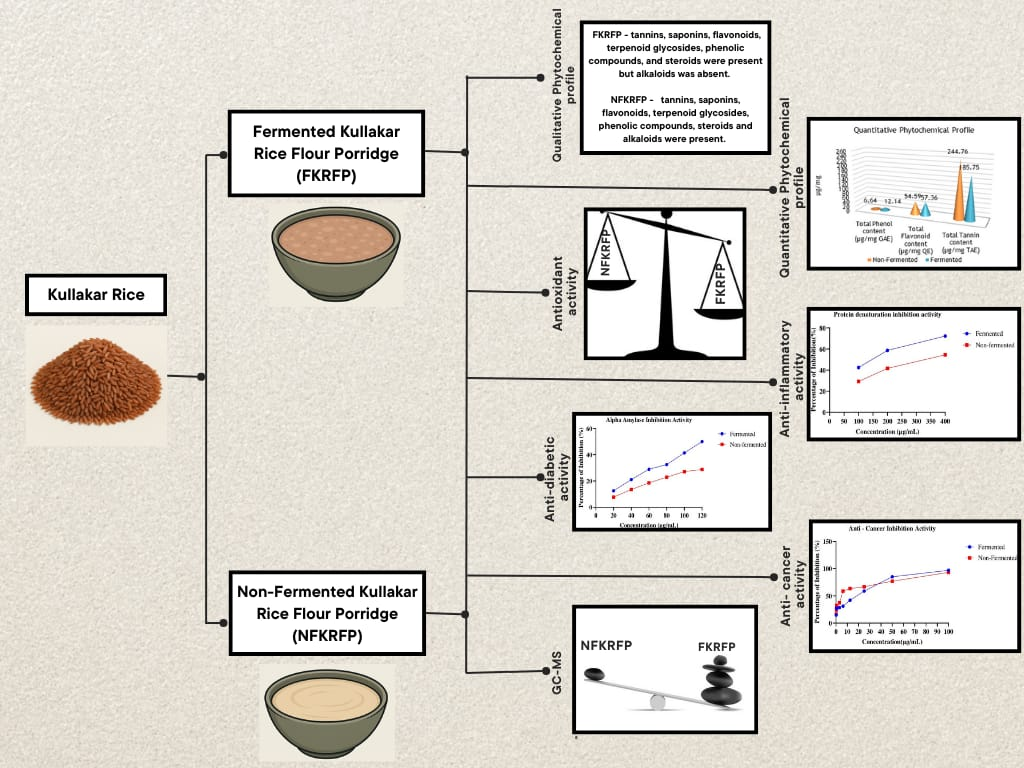
Kullakar rice, a traditional indigenous variety, is known for its rich nutritional and bio-functional properties. This study investigates the impact of fermentation on the phytochemical composition, antioxidant activity, and bio-functional potential of Kullakar rice flour porridge. Phytochemical, antioxidant and Gas Chromatography-Mass Spectrometry (GC-MS) analyses were performed using a constructive procedure. The anti-inflammatory potential was assessed using the protein denaturation inhibition assay, while the anti-diabetic potential was evaluated through alpha-amylase inhibition. The anti-cancer potential was determined using the MTT assay. Phytochemical analysis revealed that both fermented and non-fermented samples contained essential compounds, with fermentation significantly increasing total phenolic (12.14 ± 0.75 mg GAE/g) and total flavonoid (57.36 ± 0.34 mg QE/g) content while reducing tannins (185.75 ± 0.62 mg CE/g). Antioxidant activity was enhanced in the fermented porridge, as demonstrated by a higher IC50 value for DPPH• radical scavenging activity (14.87 ± 0.76 µg/mL) and superoxide radical scavenging activity (18.87 ± 0.25 µg/mL) and improved phosphomolybdenum reduction activity (15.27 ± 0.15 µg/mL) and FRAP (40.62 ± 0.30 µg/mL) values. Bio-functional studies showed that fermentation strengthened the IC50 value for anti-inflammatory (117.40 ± 1.05 µg/mL) and anti-diabetic (78.37 ± 0.50 μg/mL) properties. However, non-fermented porridge exhibited a higher IC50 value for anti-cancer activity (5.27 ± 0.21 μg/mL), which was moderated upon fermentation. GC-MS analysis identified an increased presence of bioactive compounds in the fermented sample, further supporting its functional food potential. These findings suggest that fermentation enhances the nutritional and therapeutic benefits of porridge prepared using Kullakar rice flour, making it a promising candidate for health-focused dietary applications.
Downloads
References
1. Krishnan, S. G.; Vinod, K. K.; Bhowmick, P. K.; Bollinedi, H.; Ellur, R. K.; Seth, R.; Singh, A. K. Rice Breeding, In Fundamentals of Field Crop Breeding; Springer Nature Singapore: Singapore, 2022; pp 113–220. DOI: 10.1007/978-981-16-9257-4_3.
2. Thushara, P. A. N.; Godakumbura, P. I.; Prashantha, M. A. B. Importance, Health Benefits and Bioactivities of Sri Lankan Traditional Rice (Oryza sativa L.) Varieties: A Review. Int. J. Agric. Environ. Bioresearch 2019, 4(5), 119–128. DOI: 10.35410/IJAEB.2019.119128
3. Priya, T. S. R.; Eliazer Nelson, A. R. L.; Ravichandran, K.; Antony, U. Nutritional and Functional Properties of Coloured Rice Varieties of South India: A Review. J. Ethn. Foods 2019, 6(1), 1–11. DOI: 10.1186/s42779-019-0013-1
4. Gunaratne, A.; Wu, K.; Li, D.; Bentota, A.; Corke, H.; Cai, Y. Z. Antioxidant Activity and Nutritional Quality of Traditional Red-Grained Rice Varieties Containing Proanthocyanidins. Food Chem. 2013, 138(2–3), 1153–1161. DOI: 10.1016/j.foodchem.2012.11.122
5. Srisawat, U.; Panunto, W.; Kaendee, N.; Tanuchit, S.; Itharat, A.; Lerdvuthisopon, N.; Hansakul, P. Determination of Phenolic Compounds, Flavonoids, and Antioxidant Activities in Water Extracts of Thai Red and White Rice Cultivars. J. Med. Assoc. Thail. 2010, 93, S83–S91. DOI:10.1055/s-0030-1264431
6. Pang, Y.; Ahmed, S.; Xu, Y.; Beta, T.; Zhu, Z.; Shao, Y.; Bao, J. Bound Phenolic Compounds and Antioxidant Properties of Whole Grain and Bran of White, Red and Black Rice. Food Chem. 2018, 240, 212–221. DOI: 10.1016/j.foodchem.2017.07.095
7. Shao, Y.; Hu, Z.; Yu, Y.; Mou, R.; Zhu, Z.; Beta, T. Phenolic Acids, Anthocyanins, Proanthocyanidins, Antioxidant Activity, Minerals and Their Correlations in Non-Pigmented, Red, and Black Rice. Food Chem. 2018, 239, 733–741. DOI: 10.1016/j.foodchem.2017.07.009
8. Shao, Y.; Xu, F.; Sun, X.; Bao, J.; Beta, T. Identification and Quantification of Phenolic Acids and Anthocyanins as Antioxidants in Bran, Embryo and Endosperm of White, Red and Black Rice Kernels (Oryza sativa L.). J. Cereal Sci. 2014, 59(2), 211–218. DOI: 10.1016/j.jcs.2014.01.004
9. Ashraf, A. M.; Begam, S. N.; Sivagamy, K.; Vijayashanthi, V. A.; Yogameenakshi, P. Exploring the Bioactives and Therapeutic Properties of Traditional Rice Landraces for Human Health and Food Security: A Review. Asian J. Dairy Food Res. 2024. DOI: 10.18805/ajdfr.dr-2260
10. Zhang, L.; Cui, D.; Ma, X.; Han, B.; Han, L. Comparative Analysis of Rice Reveals Insights into the Mechanism of Colored Rice via Widely Targeted Metabolomics. Food Chem. 2023, 399, Art. No: 133926. DOI: 10.1016/j.foodchem.2022.133926
11. Ito, V. C.; Lacerda, L. G. Black Rice (Oryza sativa L.): A Review of Its Historical Aspects, Chemical Composition, Nutritional and Functional Properties, and Applications and Processing Technologies. Food Chem. 2019, 301, Art. No: 125304. DOI: 10.1016/j.foodchem.2019.125304
12. Mau, J.-L.; Lee, C.-C.; Chen, Y.-P.; Lin, S.-D. Physicochemical, Antioxidant and Sensory Characteristics of Chiffon Cake Prepared with Black Rice as Replacement for Wheat Flour. LWT 2016, 75, 434–439. DOI: 10.1016/j.lwt.2016.09.019
13. Niu, Y.; Gao, B.; Slavin, M.; Zhang, X.; Yang, F.; Bao, J.; Yu, L. L. Phytochemical Compositions, and Antioxidant and Anti-Inflammatory Properties of Twenty-Two Red Rice Samples Grown in Zhejiang. LWT–Food Sci. Technol. 2013, 54(2), 521–527. DOI: 10.1016/j.lwt.2013.06.018
14. Subramanian, V.; Dhandayuthapani, U. N.; Kandasamy, S.; Sivaprakasam, J. V.; Balasubramaniam, P.; Shanmugam, M. K.; Nagappan, S.; Elangovan, S.; Subramani, U. K.; Palaniyappan, K.; Vellingiri, G.; Muthurajan, R. Unravelling the Metabolomic Diversity of Pigmented and Non-Pigmented Traditional Rice from Tamil Nadu, India. BMC Plant Biol. 2024, 24(1), Art. No: 402. DOI: 10.1186/s12870-024-05123-3
15. Amudha, K.; Geetha, S.; Manimekalai, M.; Ganesamurthy, K. Rice Landraces of Tamil Nadu–A Review. Indian J. Tradit. Knowl. 2023, 22(1), 17–29. DOI: 10.56042/ijtk.v22i1.43677
16. Howden, J. A.; Chong, Y. H.; Leung, S. Y.; Rabuco, L. B.; Sakamoto, M.; Tchai, B.-S.; Tontisiri, K.; Wahlqvist, M. L.; Winarno, F. G.; Yap, M. J. Breakfast Practices in the Asian Region. Asia Pac. J. Clin. Nutr. 1993, 2(2), 77–84.
17. Nitikornwarakul, C.; Wangpradid, R.; Sirimuangmoon, C.; Lekjing, S.; Nishioka, A.; Koda, T. Nutritious Elderly Diet: Pigmented Rice-Porridge from Shear-Heat Milling Process. Ital. J. Food Sci. 2022, 34(3), 25–34. DOI: 10.15586/ijfs.v34i3.2241
18. Qin, H.; Wu, H.; Shen, K.; Liu, Y.; Li, M.; Wang, H.; Qiao, Z.; Mu, Z. Fermented Minor Grain Foods: Classification, Functional Components, and Probiotic Potential. Foods 2022, 11(20), Art. No: 3155. DOI: 10.3390/foods11203155
19. Jaiswal, S.; Pradhan, S. N.; Jain, D.; Dhassiah, P.; Antony, U. Probiotic and Functional Characterization of Pediococcus acidilactici Isolated from Bhaati Jaanr, Traditional Fermented Rice Porridge. Appl. Biochem. Biotechnol. 2022, 194(12), 5734–5747. DOI: 10.1007/s12010-022-04041-0
20. Mir, M. A.; Sawhney, S. S.; Jassal, M. M. S. Qualitative and Quantitative Analysis of Phytochemicals of Taraxacum officinale. Wudpecker J. Pharm. Pharmacol. 2013, 2(1), 1–5.
21. Jeba, R. C.; Pooja, S.; Priyanka, P. Antioxidant and Antibacterial Work of Methanolic Extract of Helicteres isora. Plant Cell Biotechnol. Mol. Biol. 2021, 22(39 & 40), 199–209.
22. Maurya, S.; Singh, D. Quantitative Analysis of Total Phenolic Content in Adhatoda vasica Nees Extracts. Int. J. PharmTech Res. 2010, 2(4), 2403–2406.
23. Ghafar, F.; Tengku Nazrin, T. N. N.; Mohd Salleh, M. R.; Nor Hadi, N.; Ahmad, N.; Azahari, A. Total Phenolic Content and Total Flavonoid Content in Moringa oleifera Seed. Galeri Waris. Sains 2017, 1(1), 23–35. DOI: 10.26480/gws.01.2017.23.25
24. Tamilselvi, N.; Krishnamoorthy, P.; Dhamotharan, R.; Arumugam, P.; Sagadevan, E. Analysis of Total Phenols, Total Tannins and Screening of Phytocomponents in Indigofera aspalathoides (Shivanar Vembu) Vahl EX DC. J. Chem. Pharm. Res. 2012, 4(6), 3259–3262.
25. Noipa, T.; Srijaranai, S.; Tuntulani, T.; Ngeontae, W. New Approach for Evaluation of the Antioxidant Capacity Based on Scavenging DPPH Free Radical in Micelle Systems. Food Res. Int. 2011, 44(3), 798–806. DOI: 10.1016/j.foodres.2011.01.034
26. Zhu, P.; Zhang, Y.; Zhang, D.; Han, L.; Liu, H.; Sun, B. Inhibitory Mechanism of Advanced Glycation End-Product Formation by Avenanthramides Derived from Oats through Scavenging the Intermediates. Foods 2022, 11(12), Art. No: 1813. DOI: 10.3390/foods11121813
27. Bailey-Shaw, Y. A.; Williams, L. A.; Green, C. E.; Rodney, S.; Smith, A. M. In-Vitro Evaluation of the Anti-Inflammatory Potential of Selected Jamaican Plant Extracts Using the Bovine Serum Albumin Protein Denaturation Assay. Int. J. Pharm. Sci. Rev. Res. 2017, 47(1), 145–153.
28. Ferosekhan, M.; Ramu, A.; Ravikumar, S. Scientific Evaluation of Traditionally Known Insulin Plant Costus Species for the Treatment of Diabetes in Human. Int. J. Curr. Res. Biosci. Plant Biol. 2016, 3(6), 87–91. DOI: 10.20546/ijcrbp.2016.306.011
29. Mosmann, T. Rapid Colorimetric Assay for Cellular Growth and Survival: Application to Proliferation and Cytotoxicity Assays. J. Immunol. Methods 1983, 65(1–2), 55–63. DOI: 10.1016/0022-1759(83)90303-4
30. Boonyanugomol, W.; Rukseree, K.; Prapatpong, P.; Reamtong, O.; Baik, S. C.; Jung, M.; Lee, W. K. An In Vitro Anti-Cancer Activity of Ocimum tenuiflorum Essential Oil by Inducing Apoptosis in Human Gastric Cancer Cell Line. Medicina 2021, 57(8), Art. No: 784. DOI: 10.3390/medicina57080784
31. Mwamatope, B.; Chikowe, I.; Tembo, D. T.; Kamanula, J. F.; Masumbu, F. F. F.; Kumwenda, F. D. Phytochemical Composition and Antioxidant Activity of Edible Wild Fruits from Malawi. Biomed Res. Int. 2023, 2023, Art. No: 2621434. DOI: 10.1155/2023/2621434
32. Casado, N.; Casado-Hidalgo, G.; González-Gómez, L.; Morante-Zarcero, S.; Sierra, I. Insight into the Impact of Food Processing and Culinary Preparations on the Stability and Content of Plant Alkaloids Considered as Natural Food Contaminants. Appl. Sci. 2023, 13(3), Art. No: 1704. DOI: 10.3390/app13031704
33. Wang, T.; He, F.; Chen, G. Improving Bioaccessibility and Bioavailability of Phenolic Compounds in Cereal Grains through Processing Technologies: A Concise Review. J. Funct. Foods 2014, 7, 101–111. DOI: 10.1016/j.jff.2014.01.033
34. Adebo, O. A.; Medina-Meza, I. G. Impact of Fermentation on the Phenolic Compounds and Antioxidant Activity of Whole Cereal Grains: A Mini Review. Molecules 2020, 25(4), Art. No: 927. DOI: 10.3390/molecules25040927
35. Towo, E.; Matuschek, E.; Svanberg, U. Fermentation and Enzyme Treatment of Tannin Sorghum Gruels: Effects on Phenolic Compounds, Phytate and In Vitro Accessible Iron. Food Chem. 2006, 94(3), 369–376. DOI: 10.1016/j.foodchem.2004.11.027
36. Tsafrakidou, P.; Michaelidou, A. M.; Biliaderis, C. G. Fermented Cereal-Based Products: Nutritional Aspects, Possible Impact on Gut Microbiota and Health Implications. Foods 2020, 9(6), Art. No: 734. DOI: 10.3390/foods9060734
37. Juan, M.-Y.; Chou, C.-C. Enhancement of Antioxidant Activity, Total Phenolic and Flavonoid Content of Black Soybeans by Solid State Fermentation with Bacillus subtilis BCRC 14715. Food Microbiol. 2010, 27(5), 586–591. DOI: 10.1016/j.fm.2009.11.002
38. Kumar, H.; Bhardwaj, K.; Nepovimova, E.; Kuča, K.; Singh Dhanjal, D.; Bhardwaj, S.; Kumar, D. Antioxidant Functionalized Nanoparticles: A Combat Against Oxidative Stress. Nanomaterials 2020, 10(7), Art. No: 1334. DOI: 10.3390/nano10071334
39. Priyadarshini, R. D.; Beatrice, D. A.; Sivaraj, C. Antioxidant Potential, Antidiabetic, and Anti-Inflammatory Activities of White Cowpea (Vigna unguiculata L.): An In Vitro Study. Asian J. Biol. Life Sci. 2023, 12(3), 565. DOI: 10.5530/ajbls.2023.12.74
40. Prasathkumar, M.; Raja, K.; Vasanth, K.; Khusro, A.; Sadhasivam, S.; Sahibzada, M. U. K.; et al. Phytochemical Screening and In Vitro Antibacterial, Antioxidant, Anti-Inflammatory, Anti-Diabetic, and Wound Healing Attributes of Senna auriculata (L.) Roxb. Leaves. Arab. J. Chem. 2021, 14(9), Art. No: 103345. DOI: 10.1016/j.arabjc.2021.103345
41. Dey, T. B.; Chakraborty, S.; Jain, K. K.; Sharma, A.; Kuhad, R. C. Antioxidant Phenolics and Their Microbial Production by Submerged and Solid State Fermentation Process: A Review. Trends Food Sci. Technol. 2016, 53, 60–74. DOI: 10.1016/j.tifs.2016.04.007
42. Zhao, G. R.; Zhang, H. M.; Ye, T. X.; Xiang, Z. J.; Yuan, Y. J.; Guo, Z. X.; Zhao, L. B. Characterization of the Radical Scavenging and Antioxidant Activities of Danshensu and Salvianolic Acid B. Food Chem. Toxicol. 2008, 46(1), 73–81. DOI: 10.1016/j.fct.2007.06.034
43. Samtiya, M.; Aluko, R. E.; Puniya, A. K.; Dhewa, T. Enhancing Micronutrients Bioavailability through Fermentation of Plant-Based Foods: A Concise Review. Fermentation 2021, 7(2), Art. No: 63. DOI: 10.3390/fermentation7020063
44. Verni, M.; Rizzello, C. G.; Coda, R. Fermentation Biotechnology Applied to Cereal Industry By-Products: Nutritional and Functional Insights. Front. Nutr. 2019, 6, Art. No: 42. DOI: 10.3389/fnut.2019.00042
45. Sharif, M.; John, P.; Bhatti, A.; Paracha, R. Z.; Majeed, A. Evaluation of the Inhibitory Mechanism of Pennisetum glaucum (Pearl Millet) Bioactive Compounds for Rheumatoid Arthritis: An In Vitro and Computational Approach. Front. Pharmacol. 2024, 15, Art. No: 1488790. DOI: 10.3389/fphar.2024.1488790
46. Nguyen, T. H. Assessing Radical Scavenging Activity, Potential Antidiabetic, Antigout and In Vitro Anti-Inflammatory Properties of Syzygium nervosum A. Cunn. ex DC. Grown in Vietnam. J. Agric. Food Res. 2023, 12, Art. No: 100614. DOI: 10.1016/j.jafr.2023.100614
47. Mani, N.; Beatrice, D. A.; Priyadarshini, R. D. Phytochemical Analysis, In Vitro Antioxidant, Anti-Diabetic and Anti-Inflammatory Activity of Red Kidney Bean (Phaseolus vulgaris L.). Int. J. Health Allied Sci. 2024, 13(2), 4. DOI: 10.55691/2278-344X.1095
48. Maleki, S. J.; Crespo, J. F.; Cabanillas, B. Anti-Inflammatory Effects of Flavonoids. Food Chem. 2019, 299, Art. No: 125124. DOI: 10.1016/j.foodchem.2019.125124
49. Manchope, M. F.; Bertozzi, M. M.; Borghi, S. M.; Handa, C. L.; Queiroz-Cancian, M. A.; Ferraz, C. R.; et al. Fermented (By Monascus purpureus or Aspergillus oryzae) and Non-Fermented Defatted Soybean Flour Extracts: Biological Insight and Mechanism Differences in Inflammatory Pain and Peritonitis. Fermentation 2023, 9(2), 167. DOI: 10.3390/fermentation9020167
50. Zhao, Y.; Li, M.; Wang, Y.; Geng, R.; Fang, J.; Liu, Q.; et al. Understanding the Mechanism Underlying the Anti-Diabetic Effect of Dietary Component: A Focus on Gut Microbiota. Crit. Rev. Food Sci. Nutr. 2023, 63(25), 7378–7398. DOI: 10.1080/10408398.2022.2045895
51. Leonard, W.; Zhang, P.; Ying, D.; Adhikari, B.; Fang, Z. Fermentation Transforms the Phenolic Profiles and Bioactivities of Plant-Based Foods. Biotechnol. Adv. 2021, 49, Art. No: 107763. DOI: 10.1016/j.biotechadv.2021.107763
52. Haokip, T.; Beatrice, A. D.; Priyadarshini, D. R. In Vivo and In Vitro Anti-Diabetic Activity of Stinky Beans (Parkia speciosa): A Systematic Review. Discov. Food 2024, 4(1), 111. DOI: 10.1007/s44187-024-00175-8
53. Saleh, M. S. M.; Jalil, J.; Mustafa, N. H.; Ramli, F. F.; Asmadi, A. Y.; Kamisah, Y. UPLC-MS-Based Metabolomics Profiling for α-Glucosidase Inhibiting Property of Parkia speciosa Pods. Life 2021, 11(2), Art. No: 78. DOI: 10.3390/life11020078
54. Binou, P.; Yanni, A. E.; Karathanos, V. T. Physical Properties, Sensory Acceptance, Postprandial Glycemic Response, and Satiety of Cereal-Based Foods Enriched with Legume Flours: A Review. Crit. Rev. Food Sci. Nutr. 2022, 6 (10), 2722–2740. DOI: 10.1080/10408398.2020.1858020
55. Liu, B. H.; Wu, T. S.; Su, M. C.; Chung, C. P.; Yu, F. Y. Evaluation of Citrinin Occurrence and Cytotoxicity in Monascus Fermentation Products. J. Agric. Food Chem. 2005, 53(1), 170–175. DOI: 10.1021/jf048878n
56. Chang, C. Y.; Pan, T. M. Identification of Bioactive Compounds in Lactobacillus paracasei subsp. paracasei NTU 101-Fermented Reconstituted Skimmed Milk and Their Anti-Cancer Effect in Combination with 5-Fluorouracil on Colorectal Cancer Cells. Food Funct. 2019, 10(12), 7634–7644. DOI: 10.1039/C9FO01819K
57. Guo, Z.; Zhao, B.; Song, Y.; Yan, W.; Xue, L.; Liu, X.; et al. Red Fermented Rice Elution Fractions Inhibits Cancer Cell Proliferation by Regulating the FGFR1/PI3K/AKT Signaling Pathway. Fitoterapia 2024, 177, Art. No: 106079. DOI: 10.1016/j.fitote.2024.106079
58. Adebo, O. A.; Oyeyinka, S. A.; Adebiyi, J. A.; Feng, X.; Wilkin, J. D.; Kewuyemi, Y. O.; Tugizimana, F. Application of Gas Chromatography–Mass Spectrometry (GC-MS)-Based Metabolomics for the Study of Fermented Cereal and Legume Foods: A Review. Int. J. Food Sci. Technol. 2021, 56(4), 1514–1534. DOI: 10.1111/ijfs.14794
59. Sheela, P.; UmaMaheswari, T.; Kanchana, S.; Hemalatha, G.; Vellaikumar, S. Identification of Volatile Compounds in Fermented Millet-Based Beverages by Gas Chromatography–Mass Spectroscopy. App. Biol. Res. 2021, 23(3), 245-254. DOI: 10.5958/0974-4517.2021.00031.8
60. Scalzo, R.; Morassut, M.; Rapisarda, P. Oxygen radical scavenging capacity of phenolic and non-phenolic compounds in red and white wines. Cent. Eur. J. Biol. 2012, 7(1), 146–158.
61. Kao, T.T.; Wang, M.C.; Chen, Y.H.; Chung, Y.T.; Hwang, P.A. Propylene glycol improves stability of the anti-inflammatory compounds in Scutellaria baicalensis extract. Processes 2021, 9(5), Art. No: 894. DOI: 10.3390/pr9050894
62. P, S.; Zinjarde, S.S.; Bhargava, S.Y.; Kumar, A.R. Potent α-amylase inhibitory activity of Indian Ayurvedic medicinal plants. BMC Complement. Altern. Med. 2011, 11(1), Art. No: 5. DOI: 10.1186/1472-6882-11-5
63. Anand, R.; Kaithwas, G. Anti-inflammatory potential of alpha-linolenic acid mediated through selective COX inhibition: computational and experimental data. Inflammation 2014, 37(4), 1297–1306. DOI: 10.1007/s10753-014-9857-6
64. Álvarez-Sala, A.; Ávila-Gálvez, M.Á.; Cilla, A.; Barberá, R.; Garcia-Llatas, G.; Espín, J.C.; González-Sarrías, A. Physiological concentrations of phytosterols enhance the apoptotic effects of 5-fluorouracil in colon cancer cells. J. Funct. Foods. 2018, 49, 52–60. DOI: 10.1016/j.jff.2018.08.016
Downloads
Published
Issue
Section
License
Copyright (c) 2025 J Pearlin Sharon , D Annette Beatrice, R Durga Priyadarshini, Tinhoithem Haokip

This work is licensed under a Creative Commons Attribution 4.0 International License.
For all articles published in Prospects in Pharmaceutical Sciences copyright is retained by the authors. The journal publishes articles in the Open Access policy, within the CC BY 4.0 licence.
This is a human-readable summary of (and not a substitute for) the license. Disclaimer.
You are free to:
Share — copy and redistribute the material in any medium or format
Adapt — remix, transform, and build upon the material for any purpose, even commercially.
The licensor cannot revoke these freedoms as long as you follow the license terms.
Under the following terms:
Attribution — You must give appropriate credit, provide a link to the license, and indicate if changes were made. You may do so in any reasonable manner, but not in any way that suggests the licensor endorses you or your use.
No additional restrictions — You may not apply legal terms or technological measures that legally restrict others from doing anything the license permits.
Notices:
You do not have to comply with the license for elements of the material in the public domain or where your use is permitted by an applicable exception or limitation.
No warranties are given. The license may not give you all of the permissions necessary for your intended use. For example, other rights such as publicity, privacy, or moral rights may limit how you use the material.
How to Cite




