
Development of a UV spectroscopy method to validate p-coumaric acid and assess the antioxidant activity of a p-coumaric acid gel product
DOI:
https://doi.org/10.56782/pps.415Keywords:
Validation, p-coumaric acid, International Council for Harmonization (ICH), topical gel, spectroscopy, AntioxidantAbstract
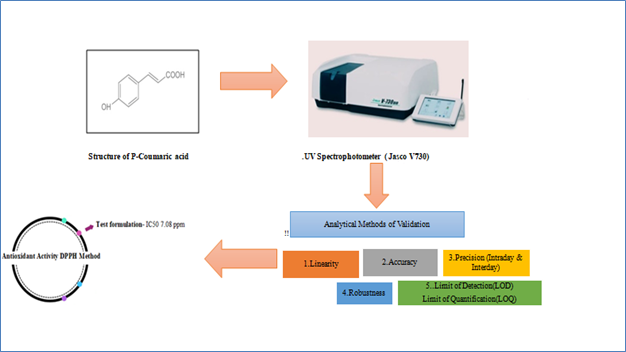
Ultraviolet spectroscopy is one of the simple, rapid, cost-effective, and precise instrumental methods. The objective of this study was the development of the UV spectroscopy method for the validation of p-coumaric acid according to the International Council for Harmonization guideline [ICH Q2 (R1)] as reported in this work. Antioxidant activity was performed by the DPPH (2,2-diphenyl-1-picrylhydrazyl) method. The UV method had not yet been developed for the above drug; this was the research gap, so validation was studied using ethanol and phosphate buffer (pH 6.8). Method A involved the preparation of the sample and standard solutions in ethanol, whereas method B involved the preparation of the solution in a mixture of phosphate buffer (pH 6.8). Two methods were employed to select unique wavelengths for drug analysis. Method A selected 229 nm, whereas method B selected 284 nm. The drug's linearity for method A and method B was found within the concentration range of 2–10 μg/mL (R2=0.98) and 5–25 μg/mL (R2=0.99), respectively, and the accuracy of both methods was evaluated by computing recovery percentages at 80, 100, and 120 percent. It was found that the recovery percentage using both approaches was between 80 and 90 percent. The lower percentage relative standard deviation (RSD) readings indicated how accurate both approaches were. The precision of the procedure was intended to be repeatable both within and between days. The fact that the % RSD value was less than 2 suggests that both approaches are accurate. With the use of ± wavelength variation, the robustness of both techniques was investigated. The active ingredient p-coumaric acid was included in the aqueous gel of HPMC K100M (hydroxypropyl methylcellulose) and Carbopol 971P polymer and its antioxidant activity was evaluated using the DDPH free radical scavenger test (IC50). The result was found to be 0.833 mg/mL. Conclusion: p-coumaric acid in pharmaceutical dosage form was successfully analyzed by the UV method and demonstrated significantly good antioxidant activity.
Downloads
References
1. Rafiee, Z.; Moaiedi, M.Z.; Gorji, A.V.; Mansouri, E.
p-Coumaric Acid Mitigates Doxorubicin-Induced Nephrotoxicity through Suppression of Oxidative Stress, Inflammation and Apoptosis. Arch. Med. Res. 2020, 51, 32–40. DOI: 10.1016/j.arcmed.2019.12.004
2. Yao, C. S.; Lin, M.; Liu, X. Wang, Y. Stilbene derivatives from Gnetum cleistostachyum. J. Asian Nat. Prod. Res. 2005, 7(2), 131–137. DOI: 10.1080/10286020310001625102
3. Gálvez, M.C.; Barroso, C.G.; Pérez-Bustamante, J.A. Analysis of polyphenolic compounds of different vinegar samples. Z. Lebensm. Unters. Forch. 1994, 199, 29-31. DOI: 10.1007/BF01192948
4. Quinde, A.; Zory, B.;, Byung K. Phenolic Compounds of Barley Grain and their Implication in Food Product Discoloration. J. Agric. Food. Chem. 2006, 54(26), 9978–9984. DOI: 10.1021/jf060974w
5. Mao, W.; Schuler, M.A.; Berenbaum, M.R. Honey constituents upregulate detoxification and immunity genes in the western honey bee Apis mellifera. Proc. Natl. Acad. Sci. USA 2013, 110, 8842-8846. DOI: 10.1073/pnas.1303884110
6. Strandas, C.; Kamal Eldin, A.; Andersson, R.; Aman P. Phenolic glucosides in bread containing flaxseed. Food Chem. 2008, 110(4), 997-999. DOI: 10.1016/j.foodchem.2008.02.088
7. Kaur, J.; Kaur, R. p-Coumaric acid: A naturally occurring chemical with potential therapeutic. Curr. Org. Chem. 2022, 26(14), 1333-1349. DOI: 10.2174/1385272826666221012145959
8. Guven, M.; Aras, A.B.; Akman, T.; Sen, H.M.; Ozkan, A.; Salis, O.; Sehitoglu, I.; Kalkan,Y.; Silan, C.; Deniz, M.; et al. Neuroprotective effect of p-coumaric acid in rat model of emboliccerebral ischemia. Iran. J. Basic Med. Sci. 2015, 18, 356–363.
9. Ferguson, L.R.; Lim, I.F.; Pearson, A.E.; Ralph, J.; Harris, P.J. Bacterial anti mutagenesis by hydroxycinnamic acids from plant cell-walls. Mutat. Res. 2003, 542(1-2), 49-58. DOI: 10.1016/j.mrgentox.2003.08.005
10. Ueda, T.; Ito, T.; Kurita, H.; Inden, M.; Hozumi, I.
p-Coumaric acid has protective effects against mutant copper-zinc superoxide dismutase 1 via the activation of autophagy in N2a cells. Int. J. Mol. Sci. 2019, 20, Art. No: 2942. DOI: 10.3390/ijms20122942
11. Barros, M.P.; Lemos, M.; Maistro, E.L.; Leite, M.F.; Sousa, J.P.B.; Bastos, J.K.; de Andrade, S.F. Evaluation of antiulcer activity of the main phenolic acids found in Brazilian Green Propolis. J. Ethnopharmacol. 2008, 120, 372–377. DOI: 10.1016/j.jep.2008.09.015
12. Kumari, B.; Khansili, A. Analytical method development and validation of UV-visible Spectrophotometric method for the estimation of vildagliptin in gastric medium. Drug Res. (Stuttg) 2020, 70(9), 417–23. DOI: 10.1055/a-1217-0296
13. Pawar, S.M.; Khatal, L.D.; Gabhe, S.Y.; Dhaneshwar S.R. Establishment of the inherent stability of pramipexole and development of validated stability-indicating LC-UV and LC-MS method. J. Pharm. Anal. 2013, 3(2), 109–117. DOI: 10.1016/j.jpha.2012.07.011
14. Priyanka, G.; Mohammad, W.; Ghadge, O. UV Spectrophotometric Method Development and Validation for Estimation of Tigecycline in Spiked Human Plasma. Int. J. Pharm. Sci. Rev. Res. 2020, 63(2), 98–101. DOI: 10.13040/IJPSR.0975-8232.13(12).5057-67
15. Kristl, A.; Podgornik, A.; Pompe, M. Simultaneous separation of insulin and six therapeutic analogues on a mixed mode column: HPLC-UV method development and application. J. Chromatogr. B Anal. Technol. Biomed. Life Sci. 2021, 1171, Art. No: 122557. DOI: 10.1016/j.jchromb.2021.122557
16. Paul, S.; Barai, L.; Husen, F.; Sarker, S.; Pal, T.K.; Bai, P. Analytical Method Development and Validation for Estimation of Ranitidine in Solid Dosage Form by UV Spectrophotometric Method. Orient. J. Chem. 2020, 36(6), 1161–1167. DOI: 10.13005/ojc/360621
17. Prasad, A.R.; Thireesha, B. UV-spectrophotometric method development and validation for the determination of lornoxicam in microsponges. Int. J. Appl. Pharm. 2018, 10(1), 74–78. DOI: 10.22159/ijap.2018v10i1.22357
18. Sun, T. et al. Comparative Study of High-throughput Screening Models for Anti-hyperpigmentation Compounds. Braz. Arch. Biol. Tech. 2022, 65, Art. No: e22210281. DOI: 10.1590/1678-4324-2022210281
19. Priani, S.E.; Aprilia, S.; Aryani, R.; Purwanti, L. Antioxidant and tyrosinase inhibitory activity of face serum containing cocoa pod husk phytosome. J. Appl. Pharm. Sci. 2019, 9(10), 110-115. DOI: 10.7324/JAPS.2019.9101510
20. Thangaraj, P. In Vitro Antioxidant Assays. In: Pharmacological Assays of Plant-Based Natural Products. Progress in Drug Research, Springer, Cham. 2016, 71. Pp. 57-72. DOI: 10.1007/978-3-319-26811-8
21. Dini, I.; Laneri, S. The New Challenge of Green Cosmetics: Natural Food Ingredients for Cosmetic Formulations. Molecules 2021, 26(13), Art. No: 3921. DOI: 10.3390/molecules26133921
22. Gülçın, İ.; Alwasel, S. DPPH Radical Scavenging Assay. Processes 2023, 11(8), Art. No: 2248. DOI: 10.3390/pr11082248
Downloads
Published
Issue
Section
License
Copyright (c) 2025 JITENDRA GAJBE, Dr.Ashwini R Madgulkar, Ms. Minakshi Shinde

This work is licensed under a Creative Commons Attribution 4.0 International License.
For all articles published in Prospects in Pharmaceutical Sciences copyright is retained by the authors. The journal publishes articles in the Open Access policy, within the CC BY 4.0 licence.
This is a human-readable summary of (and not a substitute for) the license. Disclaimer.
You are free to:
Share — copy and redistribute the material in any medium or format
Adapt — remix, transform, and build upon the material for any purpose, even commercially.
The licensor cannot revoke these freedoms as long as you follow the license terms.
Under the following terms:
Attribution — You must give appropriate credit, provide a link to the license, and indicate if changes were made. You may do so in any reasonable manner, but not in any way that suggests the licensor endorses you or your use.
No additional restrictions — You may not apply legal terms or technological measures that legally restrict others from doing anything the license permits.
Notices:
You do not have to comply with the license for elements of the material in the public domain or where your use is permitted by an applicable exception or limitation.
No warranties are given. The license may not give you all of the permissions necessary for your intended use. For example, other rights such as publicity, privacy, or moral rights may limit how you use the material.
How to Cite




